
What Makes a Pixie Work for Fine Hair Over 60
Crown volume is the whole game. Fine hair goes flat at the crown first, so the best pixies here (entries 4, 6, 12, 15) build height there — through layering, a side sweep, or a piece of texture at the top — rather than relying on teasing or heavy product. If a photograph’s crown lies flat, it is not a fine-hair pixie, however pretty the colour.
Texture beats length. A pixie for fine hair should look deliberately piecey: choppy ends, a wispy fringe, a curl or wave left visible. Blunt, one-length short cuts can make fine hair look thinner, because there is nothing to catch the light. Entries 1, 2, 5 and 9 show texture doing the thickening work — the same principle behind our pixie cuts for fine hair over 50.
The fringe question, again. A soft or side-swept fringe (entries 1, 3, 7) opens the face and hides a higher hairline without the weight of a full block fringe. A full, heavy fringe on fine hair can separate into strands by midday — if you want one, keep it wispy and ask for it to be cut dry.
Glasses change the sides. If you wear frames, the pixie’s sides must sit with them, not poke out above them — entries 10 and 15 are the reference photographs. Bring your glasses to the appointment; a cut shaped around bare ears behaves differently once frames sit on top of it.
Fine hair is not the same as thinning hair. Fine describes the width of each strand; thinning means having fewer strands, often at the hairline or crown. A pixie can make fine hair look fuller because short layers remove the weight that pulls it flat — but no haircut regrows hair or treats hair loss. If shedding or a widening part worries you, that is a question for a doctor or dermatologist, not a haircut.
19 Pixie Cuts for Women Over 60 with Fine Hair
1. The White Pixie with a Soft Fringe

The gallery’s opener, and the friendliest fine-hair pixie here: a short white cut with a soft, broken fringe that opens the face instead of covering it.
Suits: fine, straight hair; higher hairlines. Upkeep: trim every 5 weeks; fringe dusted between cuts. Ask your stylist for: a short white pixie with a soft, piecey fringe, texture through the top.
2. The Curly Gray Pixie

Proof that curl is a gift, not a problem, on fine hair: the curl gives this gray pixie its volume for free, and the short sides keep it from turning into a halo. For more curl-first ideas, see our curly pixie cuts for women over 50.
Suits: naturally curly or wavy fine hair. Upkeep: curl cream scrunched in damp; trim every 6 weeks. Ask your stylist for: a curly gray pixie, short at the sides, length left on top for the curl.
3. The Layered White Pixie with a Wispy Fringe
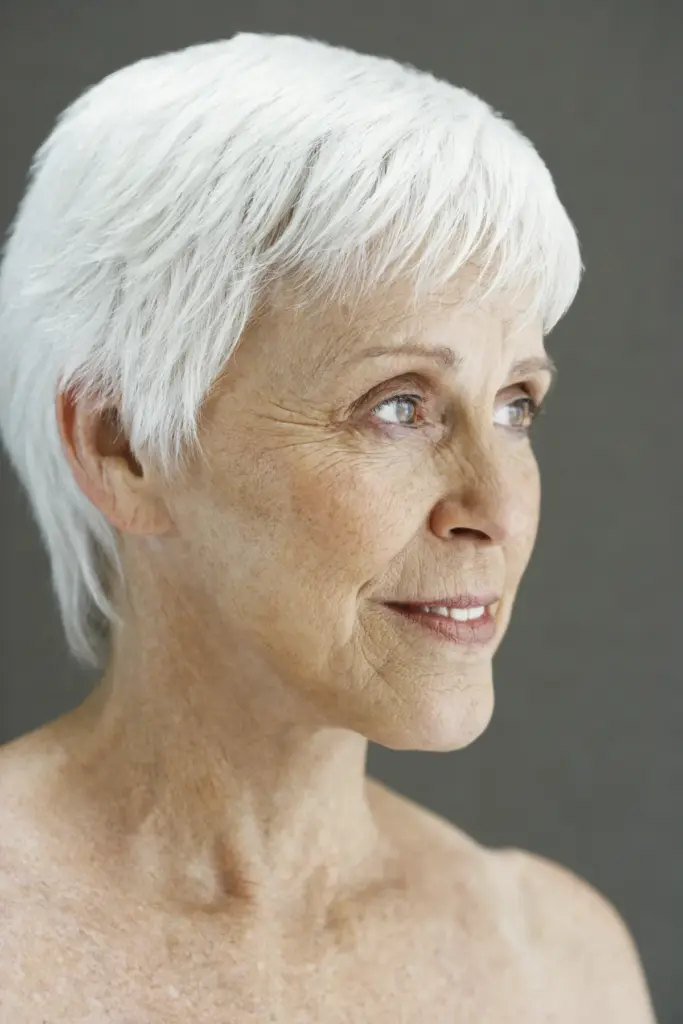
Seen from the side, this pixie’s real test is the silhouette — and it passes it. The layered white lengths taper cleanly at the nape while the wispy fringe keeps the front soft.
Suits: fine, straight hair. Upkeep: trim every 5 weeks to hold the taper. Ask your stylist for: a layered white pixie with a wispy fringe, tapered nape.
4. The Spiky Salt-and-Pepper Pixie

The boldest cut in the gallery: short, spiky, salt-and-pepper layers that stand up from the crown instead of lying down.
Suits: fine hair with some natural body. Upkeep: light paste on damp hair, piece by piece. Ask your stylist for: a spiky salt-and-pepper pixie, choppy layers at the crown.
5. The Textured White Pixie with Layered Ends
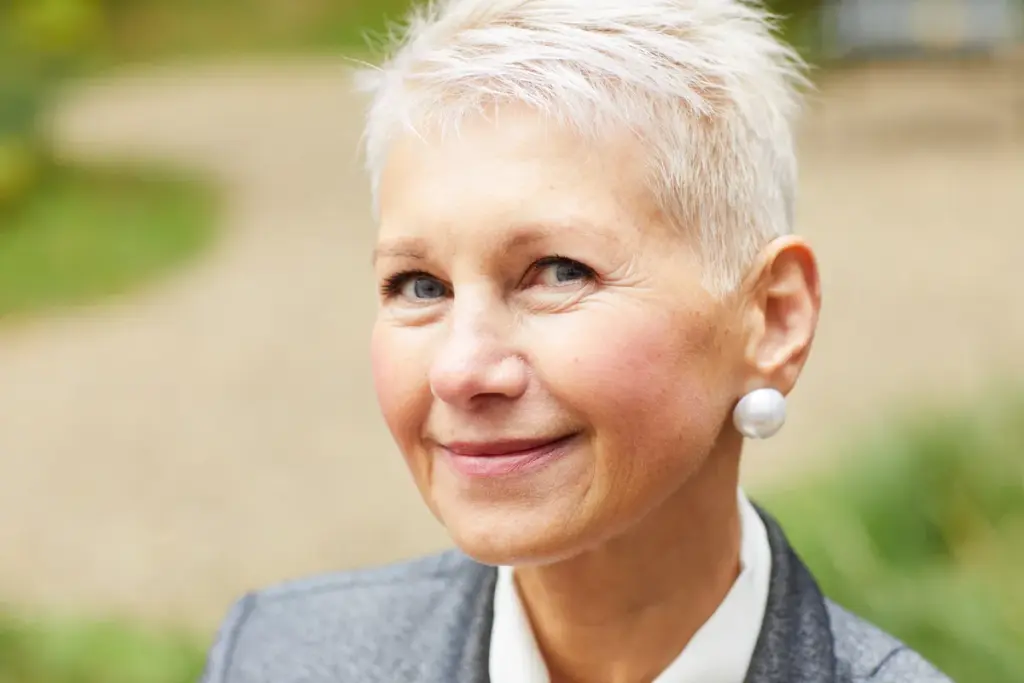
The same textured white family as entry 3, seen in daylight — and the comparison is instructive. Outdoors, the layers catch the light and the cut reads thicker than it does under studio lights.
Suits: fine, straight to slightly wavy hair. Upkeep: wash and go; trim every 5–6 weeks. Ask your stylist for: a textured white pixie with layered ends that catch the light.
6. The Tousled Silver Pixie with Full Crown Volume

The volume photograph of the gallery: a tousled silver pixie piled high at the crown, with the sides kept tight so all the height reads at the top.
Suits: fine hair that falls flat at the crown. Upkeep: volumising powder at the roots; trim every 5 weeks. Ask your stylist for: a tousled silver pixie, maximum layering at the crown, tight sides.
7. The Short Blonde Pixie with a Fringe

A softer, warmer entry: a short blonde pixie with a full-ish fringe, worn relaxed indoors. The blonde lifts the whole cut and the fringe gives the face a frame, softening the forehead without covering it.
Suits: fine hair; warm complexions. Upkeep: toner to hold the blonde; fringe trim every 4–5 weeks. Ask your stylist for: a short blonde pixie with a soft fringe.
8. The Very Short White Crop

The shortest cut in the gallery, and the most confident: a very short white crop that leaves nothing to hide behind.
Suits: very fine hair; low-maintenance routines. Upkeep: trim every 4 weeks; almost no product needed. Ask your stylist for: a very short white pixie crop, close at the sides and nape.
9. The Layered White Pixie with a Tapered Nape
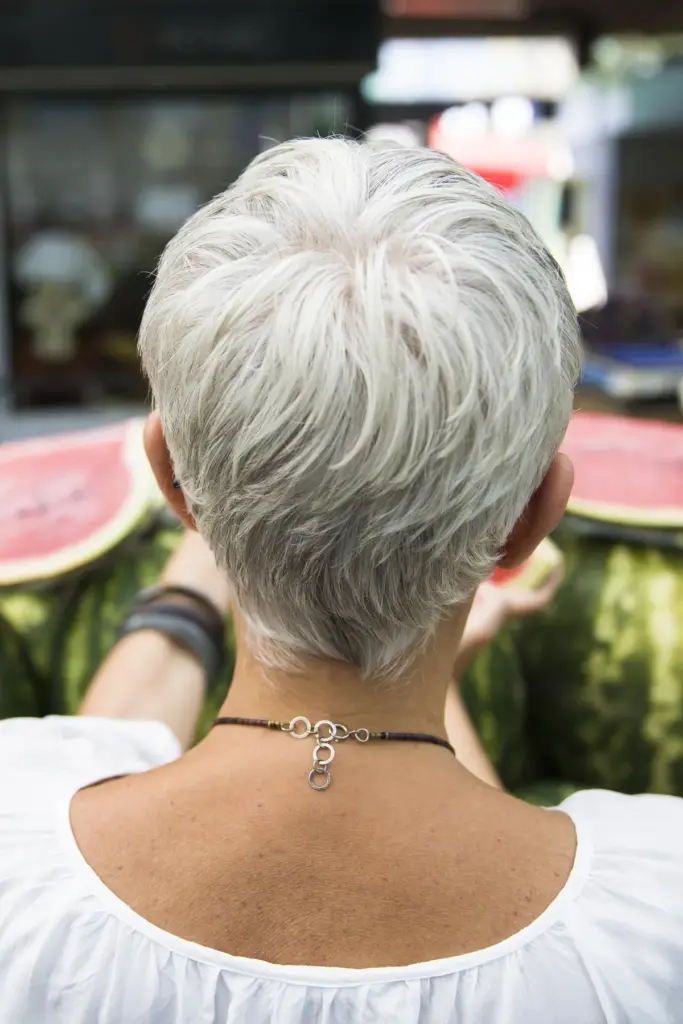
The back view every pixie should be judged by: a layered white cut with a tapered nape, the layers feathering down instead of ending in a blunt shelf.
Suits: fine, straight hair. Upkeep: nape trim every 5 weeks. Ask your stylist for: a layered white pixie with a tapered, feathered nape.