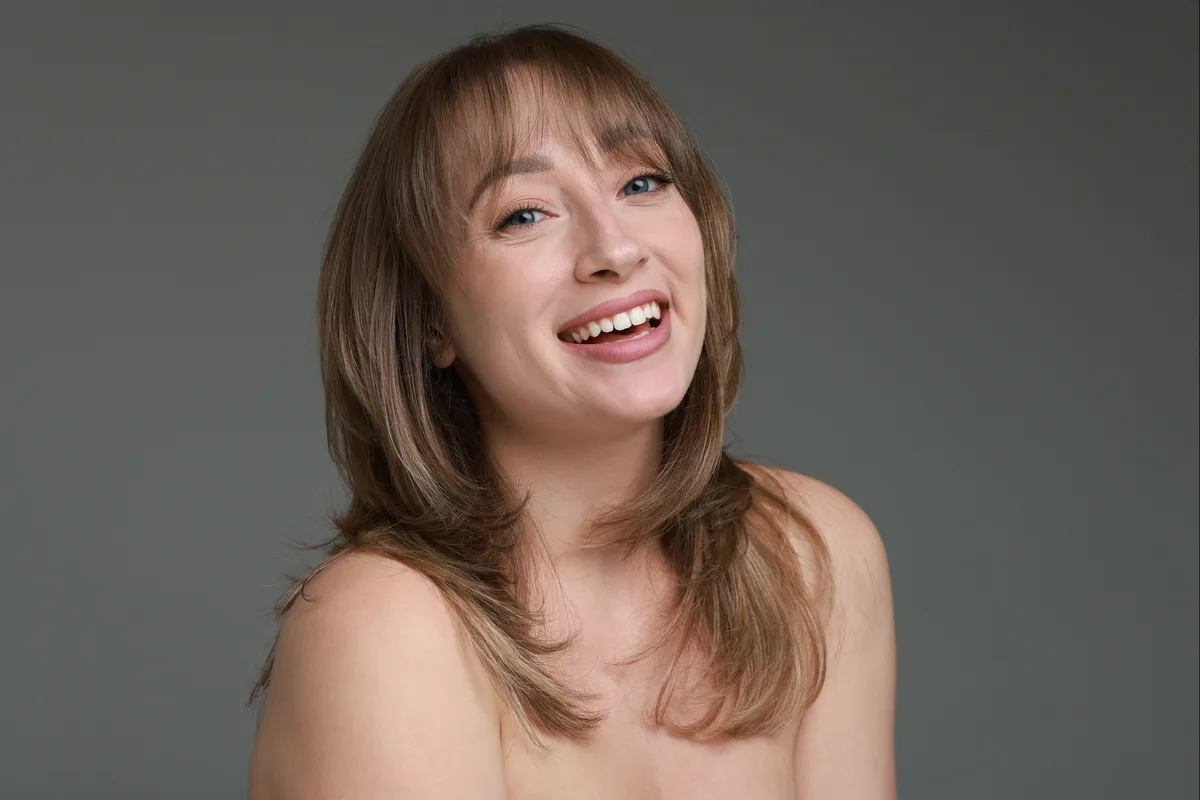
This gallery brings together seven curtain fringe looks photographed on women in their forties, fifties and early sixties. Six are real photographs licensed from Envato Elements; the final look is a clearly labelled AI visualisation, included because a silver curtain fringe is the version readers ask about most and the one stock libraries rarely photograph well. Every look passed the same test: a woman clearly in the 40–65 range, and a fringe that genuinely parts and sweeps — wispy, feathered and open, never a blunt straight line.
What Makes Curtain Bangs Soft, Not Severe
The parting does the softening. A curtain fringe is split at the centre (or just off it), so the forehead is never fully covered. That open middle is what separates it from the blunt fringe: skin shows through, the brows stay visible, and the face keeps its length.
Wispy beats dense. On finer, mature hair, a fringe cut too thick takes bulk the rest of the head cannot spare and lands heavily. Ask for a fringe that is thinned at the ends and feathered, so individual strands separate. The looks in this gallery are deliberately airy — a fringe you can see through slightly is the one that flatters.
Length is the safety net. Curtain bangs are longest where they meet the cheekbones and jaw, which means they grow out gracefully: no hard line appears at week three, trims can stretch to six or eight weeks, and if the fringe is ever regretted it simply becomes face-framing layers. Few cuts at this age are as forgiving.
Styling is measured in seconds. A curtain fringe asks for direction, not effort: blow-dry it forward, then sweep each side away from the face with a round brush or fingers, and let it fall open. It works with glasses, sits happily under a hat, and can be pinned back entirely on a no-fringe day — flexibility a solid fringe never offers.
Foreheads, glasses and cowlicks. A taller forehead is where a curtain fringe earns its keep: the open centre keeps the proportions balanced where a full fringe would shorten the face. Glasses wearers should keep the centre strands at brow length or a fraction above, so the fringe clears the frames instead of resting on them. A strong cowlick at the front hairline usually settles once the fringe has a little length and weight at the sides — one more reason to keep the outer pieces long rather than cutting the fringe short and hoping it behaves. And if the hairline itself is fine or sparse, a wispy curtain fringe is the kindest option of all: it suggests coverage without demanding density that is not there.
7 Curtain Bangs After 50: Soft, Not Severe
1. The Classic Curtain Fringe, Tapered to the Jaw

This is the reference version: a clean centre part, the shortest strands grazing the brows, then each side lengthening in a smooth taper until it meets the jaw. Worn here with the rest of the hair in a low ponytail, it proves the fringe works even when everything else is pulled back — the face stays framed and nothing reads severe.
Suits: most face shapes; anyone trying a fringe for the first time. Upkeep: low; fringe trim every 6–8 weeks. Ask your stylist for: a centre-parted curtain fringe, brow length in the middle, tapering to the jaw, ends feathered.
2. Wispy Curtain Fringe with Soft Layers
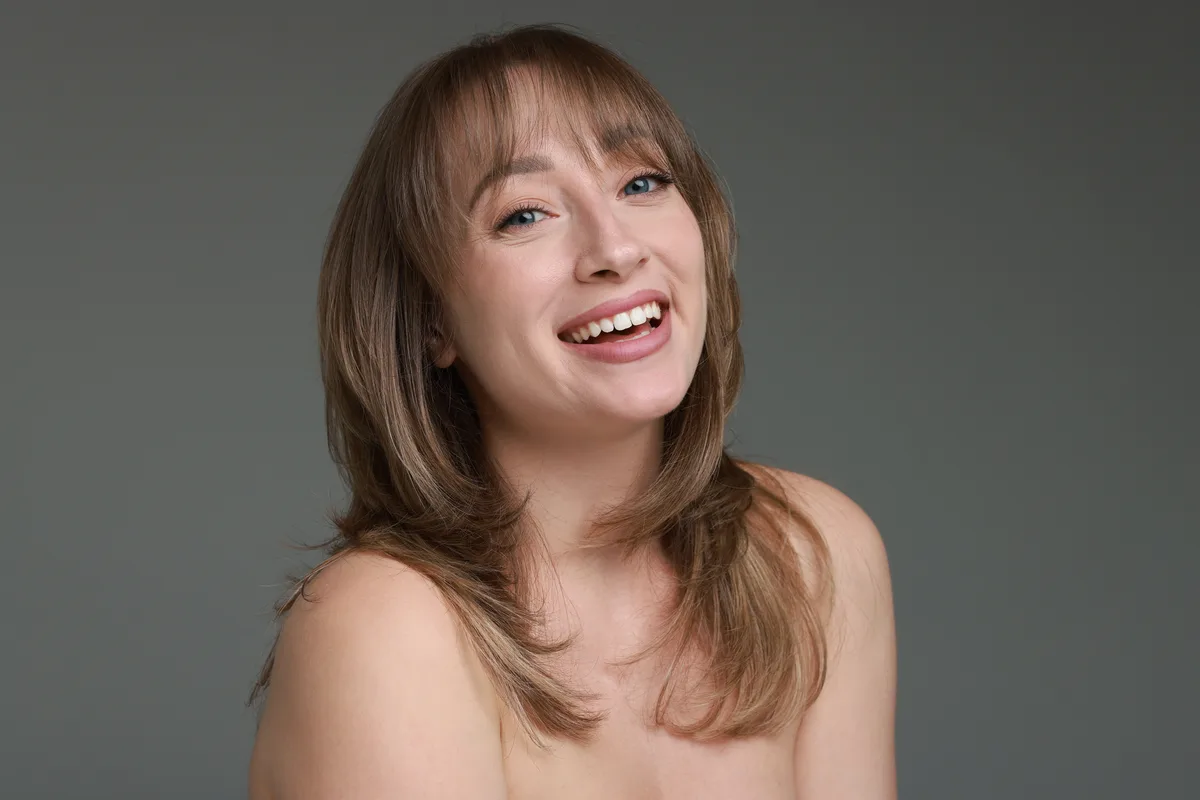
Here the fringe is lighter still — see-through wispy at the centre, with layered shoulder-length hair carrying the same softness down through the ends. The grey studio backdrop shows the shape honestly: nothing heavy anywhere, and the fringe opens the face rather than shortening it. This is the version to screenshot for a stylist if “soft” is the whole brief.
Suits: fine to medium hair; longer and oval faces. Upkeep: low; layers forgive a missed trim. Ask your stylist for: a wispy curtain fringe with long, soft layers and feathered ends throughout.